
BMW, Audi and Mercedes Windshield Replacement: What Makes European Glass Different
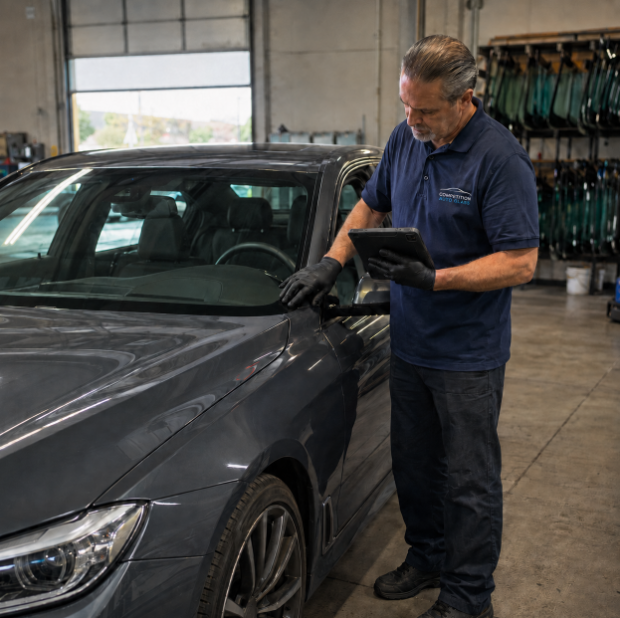
A windshield on a BMW, Audi or Mercedes-Benz is rarely just a piece of glass, and that is why the replacement takes longer and costs more than the same job on a base-model sedan. Acoustic interlayers, head-up display projection zones, rain and light sensors, heated wiper park areas and camera brackets are all built into or bonded onto the glass.
The wrong windshield specification is not always obvious on the day of installation. It shows up a week later as cabin noise at highway speed, a ghosted display, or wipers frozen down after an overnight snowfall.
What Makes European Glass Different
Option content. Two identical-looking 5 Series can take different windshields depending on how each was specified when new, and the same is true across the Audi and Mercedes-Benz ranges. A windshield is identified not just by model and year but by the combination of features embedded in it.
That is why the first question on any European job is the VIN rather than the model name. The VIN tells the supplier which glass the vehicle was built with, which removes the guesswork before anything is ordered.
Acoustic Interlayers and Cabin Noise
Many European vehicles are built with acoustic glass: a laminated windshield with a sound-damping interlayer that cuts wind and road noise. It is one of the reasons the cabin stays quiet at highway speed.
Substituting plain laminated glass on a vehicle specified with acoustic glass makes the cabin noticeably louder from around 60 mph, and there is no fix short of replacing the windshield again. Ask whether the quoted glass carries the acoustic interlayer, because it is not always obvious from a part description.
Head-Up Display Windshields
On a vehicle with head-up display, the projected image reflects off a wedge-shaped interlayer built into the glass. Standard glass produces a double or ghosted image, and the vehicle settings will not correct it.
HUD glass is a separate part and should not be substituted with standard glass. If your vehicle projects speed or navigation onto the windshield, say so when you request a quote.
Rain, Light and Humidity Sensors
Sensors mounted to the inside face of the windshield read through a precise optical window in the glass, usually behind the mirror housing. On many European vehicles the sensor sits against a gel pad that is single-use by design.
If the pad is reused or the sensor is not seated squarely in its bracket, the wipers trigger at random or fail to trigger in light rain. It is a small part with a large nuisance value, and it should be included rather than reused.
Heated Wiper Park Zones
Some European models include a heated zone at the base of the windshield that stops the wipers freezing to the glass. Through a Denver winter that is a feature you notice every morning it is missing.
The heating element is embedded in the glass with its own connector. Glass supplied without it leaves you with a dead circuit and wipers frozen down after a cold night, and correcting it means fitting the correct pane.
Camera Brackets and Recalibration
Forward-facing cameras for lane keeping, traffic sign recognition and automatic emergency braking mount to a bracket bonded to the windshield, and the position tolerance is small. Once the new glass is in, the camera has to be recalibrated so the system knows exactly where it is pointing.
On many European vehicles this is a static calibration carried out against a target board in controlled conditions rather than a road drive. Competition Auto Glass handles recalibration as part of the replacement on applicable vehicles.
OEM or OEM-Equivalent on a European Vehicle
For a standard vehicle with no embedded technology, OEM-equivalent glass is a sound choice at lower cost and meets the same safety standards. On a European vehicle carrying head-up display, acoustic glass or a camera-based driver assistance package, OEM glass is often the more appropriate option because the optical and dimensional tolerances matter more.
There is no single right answer for every car. Competition Auto Glass will talk through which applies to yours rather than defaulting to one option for everything.
What to Confirm Before You Book
- Have your VIN ready, not just the model and year
- Confirm whether the quoted glass includes the acoustic interlayer, HUD wedge, sensor bracket and heated wiper park where your vehicle has them
- Ask whether camera recalibration is included and whether it happens in the same appointment
- Check that a new sensor gel pad and new mouldings are part of the price
- Ask about lead time, because specialist European glass is sometimes ordered in rather than held in stock
Give the VIN when you call. On a European vehicle it is the difference between the correct windshield arriving first time and a second appointment a week later.
Get a Free Quote →Frequently Asked Questions
Does a BMW windshield have to be OEM?
Why does European windshield replacement cost more?
Can you replace a windshield with head-up display?
Will my rain sensor still work after a windshield replacement?
Do you need my VIN to quote a BMW, Audi or Mercedes windshield?
Further Reading
| Page | URL |
|---|---|
| OEM vs Aftermarket Windshields | https://competitionautoglass.com/oem-vs-aftermarket-windshield-denver/ |
| ADAS Recalibration After Windshield Replacement | https://competitionautoglass.com/adas-recalibration-after-windshield-replacement-denver/ |
| Auto Glass Replacement in Denver | https://competitionautoglass.com/auto-glass-replacement-in-denver/ |
Windshield Replacement
Same-day windshield replacement across the Denver metro. Insurance handled for you.
Our Services
AGRSS Certified
Industry-standard installation on every job
Lifetime Warranty
Every installation fully warranted
Insurance Handled
We file the claim and bill directly
Free Mobile Service
We come to your home or office
Competition Auto Glass
Denver's trusted auto glass specialists. AGRSS-certified technicians, OEM-quality glass, free mobile service and insurance handled on every job.