
Hail Damage and Your Windshield: What Colorado Drivers Should Know
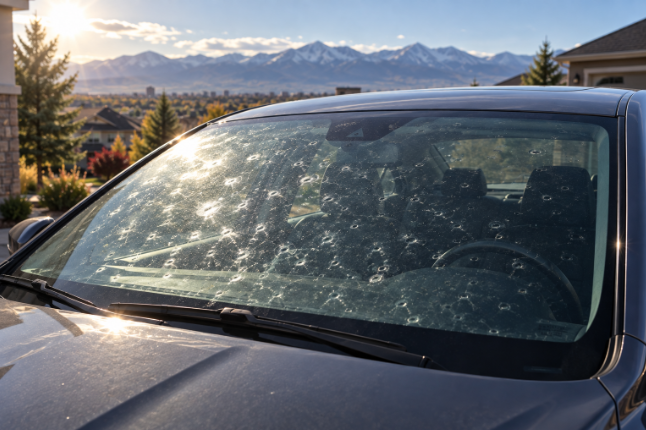
Colorado sits in one of the most active hail corridors in the United States, and the Front Range takes the worst of it between spring and early fall. Hail damage to a windshield is different from a stone chip: instead of one impact point, the glass takes multiple strikes across a wide area, and the damage frequently keeps developing for weeks after the storm has passed.
This guide covers how hail affects laminated glass, why a windshield that looks survivable often is not, and what to do in the days after a storm.
Why Hail Damage Behaves Differently
A windshield is two layers of glass bonded to a plastic interlayer, which is what stops it shattering into the cabin. A single stone strike concentrates force at one point. Hail delivers dozens of impacts across the whole pane within a couple of minutes, often at a steep angle.
The result is frequently a field of small surface pits rather than one obvious crack. Individually they look trivial. Collectively they scatter light across the entire viewing area, which is why a hail-damaged windshield often looks acceptable in the garage and becomes genuinely difficult to see through when you drive into low winter sun on the way home.
Damage That Shows Up Later
The awkward part of hail is the delay. Impacts that did not visibly break the surface can leave stress in the glass that resolves itself weeks later, usually triggered by something ordinary:
- The first hard frost after the storm
- A defroster run on high against cold glass
- A pothole or speed bump flexing the body
- A door closed firmly with the windows up
- The temperature swing between a freezing night and a bright afternoon
This is why a windshield that came through a storm apparently intact can develop a long crack from nowhere in the weeks afterwards. The crack is new. The damage that caused it is not.
What to Do in the Days After a Storm
A few things are worth doing while the event is recent and damage is easiest to document:
- Photograph the glass in daylight from inside and outside, including a shot from the driver’s seat
- Note the date of the storm, because insurers work from event dates
- Check the glass from your normal driving position rather than standing in front of the vehicle
- Look along the edges and the perimeter, where hail impacts are easiest to miss
- Avoid running the defroster on maximum against very cold glass in the days afterwards
Hail and the Law on Obstructed Vision
Colorado does not set a maximum crack length. Colorado Revised Statute 42-4-201 requires that a driver’s vision through required glass equipment is normal and unobstructed. With hail, the relevant question is not the length of any single mark but whether the cumulative pitting across the viewing area obstructs your view, particularly in low sun or at night.
How a Glass Claim Usually Works
Hail damage is typically handled under comprehensive coverage rather than collision, and depending on your policy and deductible, comprehensive coverage may cover the replacement. Because hail is a weather event rather than an at-fault incident, a glass claim following a storm is generally straightforward to submit.
Competition Auto Glass verifies your coverage with your insurer and handles the billing before work begins, so you know your out-of-pocket figure before committing. Mobile service across the Denver metro carries no additional charge, which matters after a widespread storm when workshop schedules fill quickly.
Hail Rarely Stops at the Windshield
A storm heavy enough to pit a windshield has usually reached the rest of the glass too, and the other panes fail differently. Sunroof and moonroof glass is generally tempered, so it either survives or goes completely. Rear windows on many vehicles carry a defroster grid, which means hail damage there takes the heating element with it.
Worth checking after a storm: the sunroof from inside with the shade open, the rear window along the defroster lines, and the side glass at an angle in daylight rather than straight on. Damage on curved side glass is easy to miss from directly in front of it.
Why Hail Damage Means Replacement
Competition Auto Glass is a replacement specialist and does not offer chip or crack repair. With hail that scope is less of a limitation than it sounds, because multiple impacts across the viewing area are not a patching situation in any event. Damage spread across the pane cannot be addressed point by point without leaving distortion exactly where you look through.
Replacement restores what the glass is there to do: optical clarity across the whole viewing area, structural support for the roof, and the backstop the passenger airbag deploys against. On vehicles with a forward-facing camera, recalibration is included whenever your vehicle requires it.
Photograph the glass in daylight and note the storm date while it is recent. Both make a comprehensive claim considerably easier to submit.
Get a Free Quote →Frequently Asked Questions
Can a hail damaged windshield be repaired?
Why did my windshield crack weeks after a hailstorm?
Does insurance cover hail damage to a windshield in Colorado?
Is a pitted windshield illegal to drive in Colorado?
How soon after a hailstorm should I get the glass looked at?
Sooner is better, both because damage can develop further and because insurers work from event dates. Photograph the glass in daylight and note the storm date while it is recent.
Further Reading
| Page | URL |
|---|---|
| Windshield Replacement in Denver | https://competitionautoglass.com/windshield-replacement-in-denver/ |
| Windshield Replacement Cost in Denver 2026 | https://competitionautoglass.com/windshield-replacement-cost-denver-2026/ |
Windshield Replacement
Same-day windshield replacement across the Denver metro. Insurance handled for you.
Our Services
AGRSS Certified
Industry-standard installation on every job
Lifetime Warranty
Every installation fully warranted
Insurance Handled
We file the claim and bill directly
Free Mobile Service
We come to your home or office
Competition Auto Glass
Denver's trusted auto glass specialists. AGRSS-certified technicians, OEM-quality glass, free mobile service and insurance handled on every job.