
Stress Cracks: Why Denver Windshields Break Without Being Hit
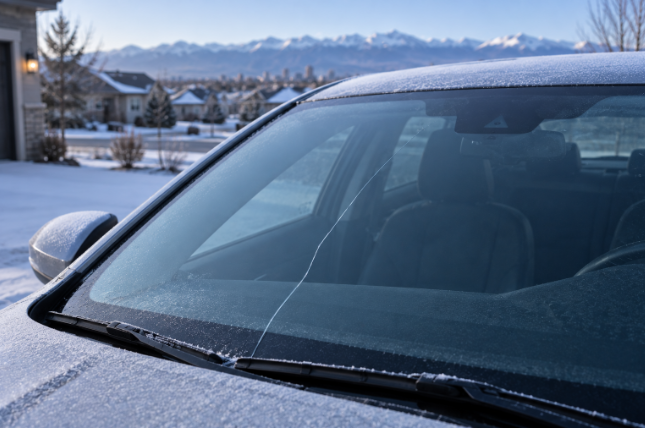
A stress crack is a crack with no impact point. Nothing hit the glass. It typically starts at the edge of the windshield and travels inward, and it is one of the most common calls we take between October and March.
The cause is thermal: glass expands and contracts with temperature, and Denver puts windshields through a bigger daily swing than almost anywhere else in the country. This guide explains why they happen here, what makes them worse, and what to do differently through winter.
What Makes Denver Particularly Hard on Glass
The Front Range routinely delivers a freezing night followed by a bright afternoon on the same day. A vehicle parked outside can go from well below freezing at 7am to warm glass in direct sun by midday, then back again. Add altitude, low humidity and intense sun, and you have conditions that cycle glass harder than a milder climate does.
Glass does not expand uniformly. The center of the pane, sitting in the sun, warms faster than the perimeter bonded to the cold body of the vehicle. That differential is exactly where a stress crack begins.
Why They Start at the Edge
The perimeter of a windshield carries the structural load and is bonded to the vehicle body. It is also where the glass is least able to move independently. When the middle of the pane wants to expand and the edge is held fast, the stress concentrates at the boundary.
A pre-existing weakness at the perimeter, including a chip you never noticed or minor damage from a previous fitment, gives that stress a place to start. Damage within roughly 2 inches of the edge is the most likely candidate.
The Defroster Mistake
The single most common trigger we hear about is a defroster run on maximum heat against very cold glass. It feels like the sensible thing to do on a frozen morning, and it is precisely the wrong approach.
Blasting hot air at the inside of a windshield while the outside sits at below-freezing temperatures creates a steep gradient across the thickness of the glass. Anything that starts warm on one face and freezing on the other is under load. Better practice through winter:
- Start the defroster on low or medium and let it climb gradually
- Give it several minutes rather than expecting a clear screen in thirty seconds
- Avoid pouring warm water on a frozen windshield, which is a reliable way to crack one
- Scrape ice mechanically rather than relying on heat alone
- Where you can, park in a garage or carport to reduce the overnight swing
Other Things That Set Them Off
Thermal load does most of the work, but mechanical flex finishes the job:
- Potholes and speed bumps, which flex the body and the bonded perimeter with it
- Closing a door firmly with all windows up, which pressurizes the cabin
- Roof racks or heavy loads changing how the body flexes
- A previous replacement where the frame was not properly prepared
- Unrepaired damage near the edge from an earlier impact
Why a Stress Crack Only Grows
Stress cracks do not stabilize. The condition that created it, the daily temperature cycle, repeats every day, and each cycle extends the crack a little further. A crack that is 3 inches in November is very often across the pane by February.
There is no patching a stress crack either. There is no impact point to fill, the crack usually reaches the edge where the structural load sits, and the glass is under active thermal load. Competition Auto Glass is a replacement specialist and does not offer chip or crack repair, which on a stress crack is not a limitation, because replacement is the only option that addresses it.
If a Stress Crack Has Already Appeared
Once you have one, the goal is to slow it down until it can be replaced rather than to stop it, because stopping it is not an option:
- Ease off the defroster and warm the cabin gradually
- Park in a garage or carport where possible, or facing away from direct morning sun
- Avoid slamming doors with the windows fully up
- Take speed bumps and rough surfaces gently
- Book the replacement rather than waiting to see whether it settles
A crack that reaches the driver’s primary viewing area or the edge of the glass has moved from an inconvenience to a vision and structural question, and Colorado Revised Statute 42-4-201 requires that your view through the windshield is normal and unobstructed.
Getting Ahead of Winter
The practical time to deal with edge damage is before the cold sets in rather than after it has propagated across the glass. If you have a chip near the perimeter, or a short crack that appeared without an impact, it is worth addressing in the fall. Mobile service across the Denver metro carries no additional charge, and most replacements are completed within 60 to 90 minutes. Bear in mind that cold weather extends adhesive cure times, so your technician will give you the safe drive-away time for the conditions on the day.
A crack with no impact point that started at the edge is a stress crack, and it will keep traveling. Dealing with it in fall is considerably cheaper than dealing with it in February.
Get a Free Quote →Frequently Asked Questions
Can a windshield crack from cold weather alone?
Why did my windshield crack when I turned on the defroster?
Will a stress crack stop spreading?
Can a stress crack be repaired instead of replaced?
Does cold weather affect how long I have to wait before driving?
Further Reading
| Page | URL |
|---|---|
| Windshield Replacement in Denver | https://competitionautoglass.com/windshield-replacement-in-denver/ |
| ADAS Recalibration After Windshield Replacement 2026 | https://competitionautoglass.com/adas-recalibration-after-windshield-replacement-denver/ |
Windshield Replacement
Same-day windshield replacement across the Denver metro. Insurance handled for you.
Our Services
AGRSS Certified
Industry-standard installation on every job
Lifetime Warranty
Every installation fully warranted
Insurance Handled
We file the claim and bill directly
Free Mobile Service
We come to your home or office
Competition Auto Glass
Denver's trusted auto glass specialists. AGRSS-certified technicians, OEM-quality glass, free mobile service and insurance handled on every job.