When a Chipped or Cracked Windshield Cannot Be Repaired
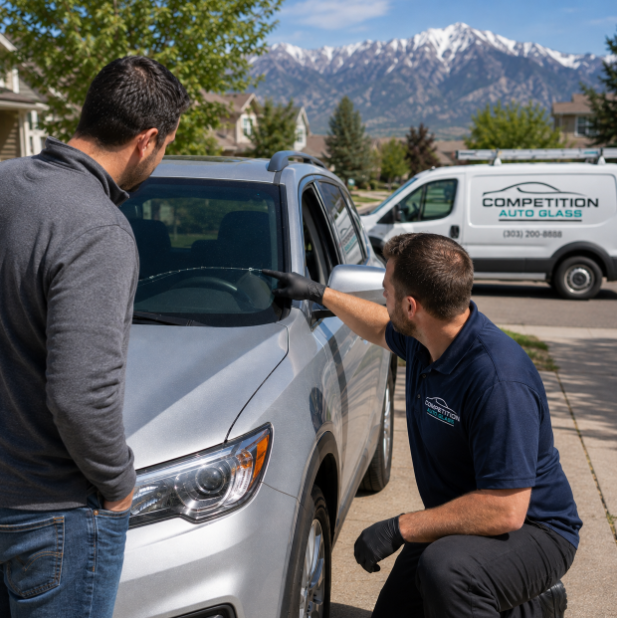
A windshield needs full replacement rather than a patch once the damage runs longer than about 6 inches, sits in the driver’s direct line of sight, reaches the edge of the glass, or interferes with a camera mounted behind it. Competition Auto Glass is a replacement specialist, so the honest starting point is this: not every chip needs new glass, and knowing which category your damage falls into saves you a wasted appointment.
This guide sets out the three factors that decide it, and how to check your own windshield before you call anyone.
The Three Things That Decide Whether Glass Can Be Saved
Every assessment comes down to size, depth and location. Get those three straight and you will know which conversation you are having.
- Size: as a general guide, chips smaller than a small coin and cracks under roughly 6 inches are candidates for a patch. Past that point the laminate is compromised across too wide an area to hold reliably.
- Depth: a windshield is two layers of glass bonded to a plastic interlayer. Damage confined to the outer layer is a different situation from damage that has reached the interlayer or the inner pane. Once the inner layer is involved, replacement is the only option.
- Location: the factor most drivers underestimate. A small chip in the wrong place is more serious than a longer crack somewhere harmless.
Cracks in the Driver's Line of Sight
Colorado does not set a maximum crack length. What the law requires, under Colorado Revised Statute 42-4-201, is that a driver’s vision through required glass equipment is normal and unobstructed. Enforcement depends on whether the damage is considered to obstruct the driver’s view, which means a chip directly in your sight line can attract a citation while a longer crack low on the passenger side may not.
There is a practical reason beyond the legal one. Damaged glass scatters light. At night, or under low winter sun on the Front Range, a crack in the sight line throws glare across exactly the part of the windshield you are looking through. Even a well-executed patch leaves visible distortion, which is why most technicians will not attempt one in the primary viewing area.
Damage at the Edge of the Windshield
Damage within roughly 2 inches of the edge usually requires replacement. The perimeter carries the structural load. It is bonded to the vehicle body and forms part of the safety cell that helps support the roof in a rollover and provides the backstop for the passenger airbag.
A crack that reaches this zone travels, because every pothole and door closure flexes the glass at exactly that point. Edge cracks also start on their own. Stress cracks that begin at the perimeter with no impact at all are common in Colorado, where a vehicle can sit through a freezing night and a bright afternoon on the same day.
Chips Near a Camera or Sensor Bracket
On any vehicle with advanced driver assistance systems, the area behind the rear-view mirror is off limits for patching. Lane departure warning, automatic emergency braking and adaptive cruise control rely on a forward-facing camera looking through a specific section of glass. A patch inside that field of view distorts what the camera sees, and the system has no way of knowing it is working from a compromised image.
If your damage sits in or near that housing, the glass is replaced and the camera is recalibrated afterwards. On those vehicles, recalibration is not optional.
How to Check Your Own Windshield in Under a Minute
Before you call anyone, five checks from the driver’s seat will tell you most of what a technician would.
- Look at the damage from your normal driving position. If it sits in the area the wipers sweep in front of you, treat it as a replacement.
- Measure the longest dimension against a banknote. Longer than a dollar bill is a strong indicator.
- Run a fingernail lightly across it. If the nail catches and drops in, the damage has broken the surface layer.
- Check the distance to the nearest edge of the glass. Inside 2 inches, assume replacement.
- Look up at the mirror housing. If there is a camera behind the glass, ask about recalibration when you call.
What a Replacement Involves and How Long You Are Off the Road
Competition Auto Glass works to a 7-stage process. The old glass and the original adhesive are removed, the frame is inspected for damage, corrosion or debris, the new windshield is set and sealed to manufacturer specification, and the finished installation is leak tested before the job is signed off. Most windshield replacements are completed within 60 to 90 minutes.
The adhesive then needs time to reach strength before the vehicle is safe to drive, and your technician will give you the safe drive-away time for the product used on your job. Mobile service across the Denver metro carries no additional charge, so the work can happen in your driveway or at your workplace rather than in a waiting room.
Why Competition Auto Glass Replaces Rather Than Repairs
Competition Auto Glass is a replacement specialist and does not offer chip or crack repair. That is a deliberate scope. Replacement work carries its own requirements: OEM or OEM-equivalent glass matched to the vehicle, AGRSS-approved adhesives, correct frame preparation and, on vehicles with driver assistance cameras, recalibration handled in the same appointment.
If your damage is small, shallow and well away from the sight line and the edge, a patch may be the right answer and worth pursuing elsewhere. If it fails any of the checks above, a full replacement is the only option that restores what the glass is there to do. Call with your vehicle year, make, model and trim and the team will tell you which category you are in before anything is booked.
The fastest way to get a straight answer is a photo of the damage and your vehicle details. Competition Auto Glass can confirm over the phone whether your windshield needs a full replacement, and check your insurance coverage in the same call.
Get a Free Quote →Frequently Asked Questions
Can a cracked windshield be repaired or does it need replacing?
How long can you drive with a cracked windshield in Colorado?
Is a chip in front of the driver worse than a longer crack?
Why does damage at the edge of the windshield mean replacement?
Does Competition Auto Glass repair windshield chips?
Further Reading
| Page | URL |
|---|---|
| ADAS Recalibration After Windshield Replacement | https://competitionautoglass.com/adas-recalibration-after-windshield-replacement-denver/ |
| Windshield Replacement in Denver | https://competitionautoglass.com/windshield-replacement-in-denver/ |
Cracked Windshield Replacement
Same-day windshield replacement across the Denver metro. Insurance handled for you.
Our Services
AGRSS Certified
Industry-standard installation on every job
Lifetime Warranty
Every installation fully warranted
Insurance Handled
We file the claim and bill directly
Free Mobile Service
We come to your home or office
Competition Auto Glass
Denver's trusted auto glass specialists. AGRSS-certified technicians, OEM-quality glass, free mobile service and insurance handled on every job.